On this page, discover:
What are the Different Types of Copper Tubing?
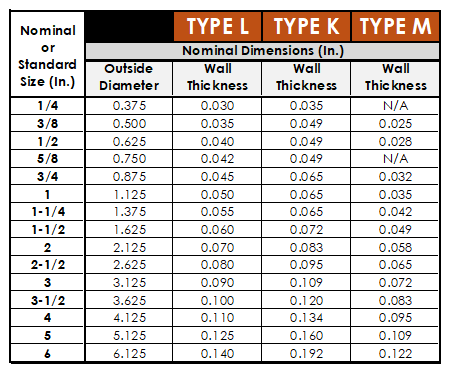
There are 4 types of copper tubing: Type K, Type L, Type M, and DWV What differentiates each type of copper tubing is their wall thickness. Wall thickness refers to the measured distance between the tube’s inner and outer surfaces.
The following example shows the general difference in wall thickness of all 4 types, for a 1.5” sized Tube.
| Copper Tubing Type | Wall Thickness |
| Type K | 0.072" |
| Type L | 0.060" |
| Type M | 0.049" |
| DMV | 0.042" |
Copper tubing is used in plumbing applications because of its antimicrobial properties and its ability to withstand high temperatures without releasing toxins. The most common type of copper for plumbing applications is type L for several reasons:
Type K is commonly used in commercial plumbing projects, HVAC and refrigeration due to its strength.
Type L is also easy to work with and install into piping systems. Inventorying type L allows wholesalers to serve residential and commercial contractors who rely on Type L for plumbing applications. Wholesalers can position themselves as a trusted partner committed to providing copper tubing that performs well under fluctuating pressure, temperature shifts, and any specific environment.
Type M is commonly used in low pressure plumbing systems (e.g. any type of domestic water line). Other uses of type M are residential water supply systems and hot and cold-water plumbing systems.
Due to its high strength & safety, Copper tubing also plays a role in industrial applications such as HVAC/R systems. Additional applications include hydraulic systems, process piping, and industrial machinery.
Type K copper tubing, known for its thick walls, is the standard choice for underground installations and gas applications. It also offers excellent heat‑transfer capabilities, enabling renewable energy systems to operate efficiently and helping reduce carbon emissions.
The most common type of copper tubing used in these applications is Type L due to its ability to withstand severe, high-pressure environments. Type L copper offers industrial applications its strength, durability, and cost-effectiveness.
Type M copper tubing is intended for above‑ground industrial uses, including commercial plumbing and HVAC systems. Its lightweight design allows for easier installation and helps lower transportation costs, making it a reliable choice for these applications.
Copper tubing sizes include ¼” to 6” CTS (Copper Tube Size). Copper tubing is measured using CTS, which stands for copper tube size. The tubing’s outer diameter is always 1/8” larger than the nominal size designation. For example, a 1” Copper Tube will have an OD of 1.125”
Smaller diameters are generally used for refrigerant lines and any appliances that need water. Larger diameters are used for more large-scale infrastructure projects, like water supply systems, sewage plants, and industrial settings.
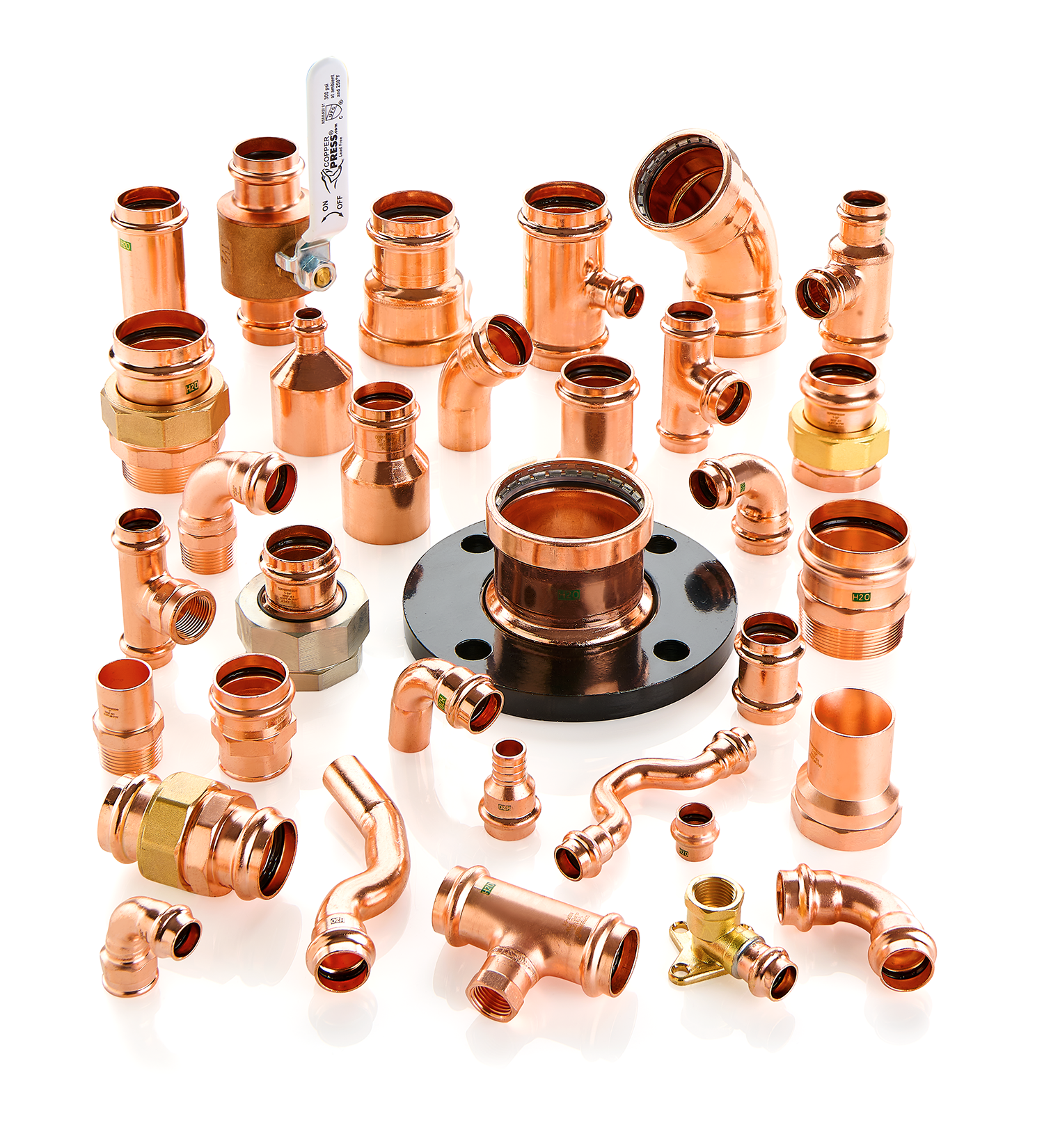
The diversity of sizes enables wholesalers to serve plumbing, HVAC/R, mechanical and industrial customers using a singular product family. This also enables wholesalers to increase turns and decrease slow-moving inventory risks. Lastly, inventorying copper tube gives wholesalers the flexibility to cross-sell with the piping products traditionally offered with copper tube (i.e. copper press fittings and valves and copper sweat fittings.
LEARN MORE ABOUT COPPER TUBING
Long service life of copper tube is a result of durability and longevity as well as its corrosion resistance due to its chemical composition. Copper tubing can last anywhere between 50 to 70 years.
When in underground environments, copper has a natural protective film that forms to protect the surface, making it a noble metal. This natural film is made from reddish-brown cuprous oxide, Cu 20. (Always refer to below ground installation codes per the local Authority Having Jurisdiction “AHJ”)
Copper tube also resists scaling which reduces constant maintenance and relinquishes low water pressure. For wholesalers, this results in a reduction in complaints and returns.
Copper tube’s durability and ability to be shipped in either a coil, or straight tube makes it easy for wholesalers to manage it in their warehouses.
For contractors, it is easy to install because it can be bent and shaped into tight spaces. It also is compatible with several joining methods (press, sweat, brazing, grooved coupling, and push), giving contractors flexibility and speed in the field. Lastly, its performance spans over decades, giving contractors peace of mind that their piping systems will have longevity.
Wholesalers trust Merit Brass due to our 89+ years history as a leading pipe nipple manufacturer and master distributor of pipe, valve, and fitting (PVF) product.
At Merit, as a PVF supply partner, we deliver inventory optimization to increase your higher turns, lower your overall total costs and offer expert buying guidance so you can win bids with confidence. In addition Merit's inventory of copper press fittings and valves, enables wholesalers to provide complete copper systems combined with complete offering.
Copper tubing is a hollow metal tube measured in CTS (Copper Tube Size). It is measured by exact wall thickness. Copper tube has tighter tolerances for precise applications.
Copper pipe is round, thin-walled pipe measured in nominal pipe size (NPS). It is measured by scheduled wall thickness (e.g. Schedule 40, 80, etc.). Copper pipes have looser tolerances. Generally, the “Pipe” would be Brass, not Copper. Sometimes people will mix up and refer to “Brass” pipe as “Copper” pipe.
The stronger type of copper is L due to the fact of type L has a thicker wall thickness than Type M. This makes it more resistant to physical damage, corrosion, and higher pressure. In addition, Type L provides superior longevity compared to type M.
When comparing the two types of copper tubing, type K is the thickest, making it the strongest.
Type K copper tubing is used more for underground and high-pressure water applications as type L is used in home applications and it is the standard choice for any interior water systems. Type L is most used.
Copper tubing will not melt in a fire, and it will not release any toxic gas. Copper’s melting point is about 2000 degrees Fahrenheit. Copper is also not combustible so if there was a fire, copper will not carry the fire with it.
If the water supply involves high-pressure, type K will be the best option due to its wall thickness. If the situation is more residential, then type L will be the best option because it is the standard option for residential piping systems. If there is low pressure, type M will be the best option because it would be strong enough to handle the pressure.
FAQ
LEARN MORE