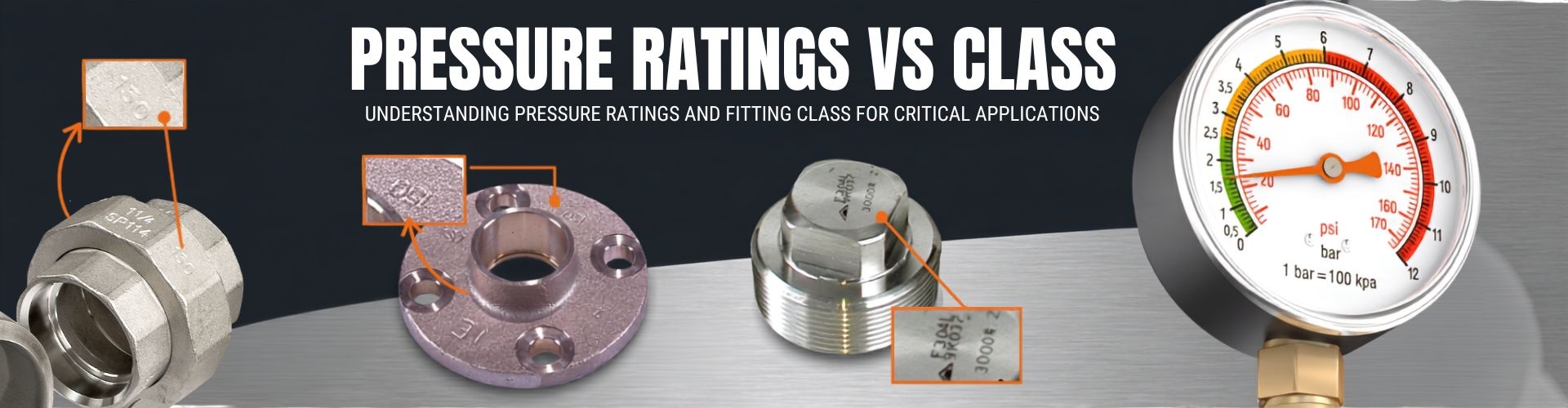
Pipes, Valves, and Pipe fittings often utilize a pressure rating, but many times individuals confuse the Class associated with these products to represent the actual pressure rating. Classes, associated with fittings and valves, are dimensionless numbers used to provide guidance when discussing how strong certain pipe fittings are.
You may ask, what is a pressure rating? The pressure rating of a fitting/valve, or its Maximum Allowable Working Pressure (MAWP), is the maximum pressure a fitting/valve can safely operate at for prolonged periods of time. Manufacturers use mathematical calculations, performance testing, and a Factor-of-Safety (FOS) to determine what a fitting/valve's MAWP will be.
Additionally, various Standards have taken into account pipe fittings/valves shapes, dimensions, materials, connection ends, and temperatures to calculate appropriate pressure ratings. The American Society of Mechanical Engineers (ASME) B16 series of Standards has many of the Classes that would be relevant in the PVF (pipe, valve & fitting) industry.
Common ASME B16 Series Standards for the PVF Industry
| ASME Standard | Type of Products | Classes |
|---|---|---|
| ASME B16.1 | Gray Iron Pipe Flanges and Flanged Fittings | Classes 25, 125, and 250 |
| ASME B16.3 | Malleable Iron Threaded Fittings | Classes 150 and 300 |
| ASME B16.4 | Gray Iron Threaded Fittings | Classes 125 and 250 |
| ASME B16.5 | Pipe Flanges and Flanged Fittings, NPS ½ through NPS 24 | Classes 125, 150, 250, 300 |
| ASME B16.11 | Forged Fittings, Socket-Welding and Threaded | Classes 2000, 3000, 6000 |
| ASME B16.15 | Cast Copper Alloy Threaded Fittings | Classes 125 and 250 |
| ASME B16.24 | Cast Copper Alloy Pipe Flanges, Flanged Fittings, and Valves | Classes 150, 300, 600, 900, 1500, and 2500 |
| ASME B16.42 | Ductile Iron Pipe Flanges and Flanged Fittings | Classes 150 and 300 |
All fittings (regardless of type/material) that are identified by a "Class" have a Pressure Rating associated with them. This Pressure is determined by the operating temperature of the piping system, and takes into account how the fitting material reacts to the operating temperature. Often times, we will hear from individuals that "this fitting is Class 300, it must have a 300psi pressure rating." Comments along these lines are not correct, and could potentially lead to serious injuries.
Various standards will have a pressure-temperature table that calls out what the pressure rating of a specific pipe fitting is, at a specific operating temperature. The below example is from ASME B16.15 and governs how Cast Copper Alloy Fittings are rated by class for a given operating temperature.
ASME B16.15 – Table I-1: Cast Copper Alloy Threaded Fittings
| Temperature (°F) | Class 125 (psi) | Class 250 (psi) |
|---|---|---|
| -20 to 150 | 200 | 400 |
| 200 | 190 | 385 |
| 250 | 180 | 365 |
| 300 | 165 | 335 |
| 350 | 150 | 300 |
| 400 | 125 | 250 |
At a system operating temperature of 200° F, a class 125 fitting would have a pressure rating of 190PSI, while a class 250 fitting would have a pressure rating of 385PSI.
As stated above, material and temperature play a major part in determining a fitting/valve's pressure rating. ASME B16.5 Table 1.1-1 (and the subsequent Pressure-Temperature Ratings Tables for other materials) not only calls out the material but can reference how the material is produced (Forging, Casting, or Plate). The material designations for Group 2.2 are shown below.
ASME B16.5 – Table 2-2.2C: Group 2.2 Material Designations
| Nominal Designation | Forgings | Castings | Plates |
|---|---|---|---|
| 16Cr-12Ni-2Mo | A182 Gr. F316 (1) | A351 Gr. CF3M (2) | A240 Gr. 316 (1) |
| 16Cr-12Ni-2Mo | A182 Gr. F316H | A351 Gr. CF8M (1) | A240 Gr. 316H |
| 18Cr-13Ni-3Mo | A182 Gr. F317 (1) | ... | A240 Gr. 317 (1) |
| 19Cr-10Ni-3Mo | ... | A351 Gr. CG8M (3) | ... |
ASME B16.5 – Table 2-2.2C: Group 2.2 Working Pressures
| Temp (°F) | Working Pressures by Classes, psig | ||||||
|---|---|---|---|---|---|---|---|
| Class 150 | Class 300 | Class 400 | Class 600 | Class 900 | Class 1500 | Class 2500 | |
| -20 to 100 | 275 | 720 | 960 | 1,440 | 2,160 | 3,600 | 6,000 |
| 200 | 235 | 620 | 825 | 1,240 | 1,860 | 3,095 | 5,160 |
| 300 | 215 | 560 | 745 | 1,120 | 1,680 | 2,795 | 4,660 |
Once the material and manufacturing process has been determined, the next step is to follow the chart to determine the working pressure at the operating temperature for the class of fitting/valve in question. The below example will walk you through determining a working pressure for a ductile iron (A536 65-45-12) fitting.
ASME B16.42 – Table 3.1-1C: Ductile Iron Pipe Flanges & Flanged Fittings
| Temperature (°F) | Working Pressure, psi | |
|---|---|---|
| Class 150 | Class 300 | |
| -20 to 100 | 250 | 640 |
| 200 | 235 | 600 |
| 300 | 215 | 565 |
| 400 | 200 | 525 |
| 500 (Note 1) | 170 | 495 |
| 600 | 140 | 465 |
| 650 | 125 | 450 |
Note 1: The maximum temperature for ASTM A536 Grade 65-45-12 is 500°F.
ASME B16.42 Table 3.1-1C.
Class: 300
Operating Temperature: 300° F
Following the Table, it shows that in this configuration, a 300 Class Fitting operating at 300° F will have a Working Pressure of 565 psi.
What should become apparent is that almost always the class of a fitting/valve does not signify the working pressure. Multiple factors need to be taken into consideration when determining what pressure a given fitting/valve will perform under for optimal performance. Differences in base material and operating temperature have the largest influence on the working pressure of a fitting, but other factors such as connection method, the standard being specified, what is flowing in the pipe (application) will also play a role.
The below tables from ASME B16.5, and MSS-SP-114 will show the difference between class 150 stainless steel (316) fittings threaded vs socket weld. ASME B16.5 will govern the Socket Weld Flange, while MSS-SP-114 will govern the Threaded Fitting. Even though both fittings are made from Stainless Steel (316), and are designated "Class 150", they have different Pressure Ratings when the two Standards are applied.
The B16.5 socket weld ratings come from the Group 2.2 material table shown earlier, while the threaded ratings come from MSS-SP-114 below. You can browse Merit's stainless steel 150# fittings in the ordering catalog.
MSS SP-114 – Table 1: Class 150 Castings & Class 1000 Wrought Fittings
| Temperature (°F) | Class 150 – Castings (psig) | Class 1000 – Wrought (psig) |
|---|---|---|
| -20 to 150 | 300 | 1000 |
| 200 | 265 | 910 |
| 250 | 225 | 825 |
| 300 | 185 | 735 |
| 350 | 150 (a) | 650 |
| 400 | – | 560 |
| 450 | – | 475 |
| 500 | – | 385 |
| 550 | – | 300 |
Note (a): Permissible for service temperature up to 366°F, reflecting the temperature of saturated steam at 150 psig.
Class 150 Stainless Steel (316) ASME B16.5 Socket Weld Flange at 200° F = 235psi pressure rating
Class 150 Stainless Steel (316) MSS-SP-114 Threaded Fitting at 200° F = 265psi pressure rating
The application for the piping system (what is flowing in the pipes and its intended purpose) will also play a factor in the pressure rating. ASME B31.3 (Process Piping) has guidelines which will limit the established class's pressure-temperature rating depending on what the pipe system is constructed from and what the application parameters call for. This is generally reflected as a firm maximum pressure allowed for a specific fitting or application, or some form a limiting factor (Factor-of-Safety) applied to the results of a Pressure-Temperature Table.
As you can see from the above, a fitting with a class does not guarantee that is the pressure rating, nor is it a "one-size-fits-all" statement to establish a pressure rating. The engineers designing the system must take all of the above factors, and many more that were not discussed, into consideration when choosing the piping components for their design. Having a baseline understanding of what class is and how it needs to be applied to the components of a piping system is a benefit to anyone involved in the PVF community.
Explore the Merit Brass Ordering Catalog
Explore product information, technical documents, and educational articles related to pipe, fittings, flanges, and pressure standards.
Browse Merit's PVF product lines by category, alloy, and industry, and access the product documents and technical resources wholesale teams rely on.
 Products by Category Explore core PVF product lines or browse the full online catalog.
 Browse Merit's core PVF product families, then use MBWebXpress to access the complete online catalog and ordering platform.

Browse Merit pipe fitting product families and available material options.
Explore Pipe Fittings
Explore standard and special fabricated pipe nipple solutions, manufactured here in Cleveland.
Explore Pipe Nipples
Review pipe flange options for a range of piping system requirements.
Explore Pipe Flanges
Explore MeritPress™ fittings and valves for supported piping systems.
Explore Press Fittings & Valves
Access stainless steel tubing products and supporting information.
Explore Stainless Steel Tubing
Explore PTFE thread seal tape for piping connection needs.
Explore PTFE Thread Tape Products by Alloy Find PVF products across Merit's available alloy and material families.
 Use Merit's alloy paths to connect material requirements with available product families, technical information, and ordering options.
PVF products in Type 304 and Type 316 stainless steel for corrosion-resistant piping requirements.
Explore Stainless SteelPipe, nipples, fittings, valves, and flanges across supported leaded & lead-free brass product options.
Explore BrassExplore ASTM A420 press products and ASTM A105N forged carbon steel product paths.
Explore Carbon SteelChrome-plated brass fittings, nipples, and flanges for supported applications.
Explore Chrome-Plated BrassLightweight 6061-40 aluminum pipe and pipe nipple product options.
Explore 6061-40 AluminumBlack and galvanized malleable iron fittings and flanges for durable piping connections. Available via special order.
Explore Malleable Iron Products by Industry Explore PVF solutions for the industries and applications your customers serve.
 Merit helps wholesale distributors connect PVF product options and support resources with the industries and applications their customers serve.
Explore products for industrial processing and demanding piping environments.
Explore Industrial
Support standard and special product requirements for original equipment manufacturers.
Explore OEM
Review PVF piping system products for food processing, packaging, and facility piping needs.
Explore Food & Beverage
Support municipal water, public works, and infrastructure product needs.
Explore Municipal Product Resources Access product documents, technical information, catalogs, and customer tools.
 Access the product documents and technical information wholesale teams use for quoting, product review, submittals, and project support.
Browse product catalogs by material, product family, and technical need.
Explore Product Catalogs
Access dimensional information and product drawings for Merit product lines.
Explore Product Dimensions
Download product submittals for project planning and documentation needs.
Explore Submittals
Access downloadable Revit files for piping product and project reference.
Explore Revit Files
Browse additional technical documents, policies, line cards, flyers, and tools.
Explore Resource CenterWhen discussing pipe fittings, the term “Class” can trace its origins back to the late 1800s and the founding of the American Society of Mechanical Engineers (ASME). At that time there were an estimated 100K Boilers in operation in the United States, with failures occurring almost every day. The severity, and loss of life, that occurred resulted in a need for standardization and the subsequent founding of ASME. Starting with ASME’s first Standard (Code for the Conduct of Trails of Steam Boilers), and additional early Standards set expectations of strength and performance based on the pressure of saturated steam within these Boilers. Fittings were initially given “150 lb”, or higher, classifications. Over time, and with new materials and manufacturing processes, the term “Pound” became a tripping point. Products made with different materials could withstand different “Pound” classifications, so a new dimensionless term needed to be created. It is from this need that the Standards settled on the term “Class” to represent this dimensionless term.
Nothing. The American National Standards Institute (ANSI) does not write Standards, it is an organization that ensure Standards Developing Organizations (SDOs) are following correct procedures as they create Standards. Additionally ANSI acts to harmonize Standards across various SDOs by ensuring alignment of procedures, testing, and wording, between the Standards which will be combined or harmonized. That is why when you look at a Standard such as ASME B16.5, it’s official title is actually ANSI/ASME B16.5. ANSI did not write the Standard, they simply ratified and approved ASME’s Standard through ANSI’s accreditation process as well.
Yes, it is possible to mix different Classes within the same piping system. Control Valves and Manifolds are required to keep the different Classes separated into different sections of the overall piping system. However, if you wanted to use different Classes all within a single section of the piping system the pressure allowed in the system will always be dictated by the lowest Class used in the system. Additionally, there are physical differences between the various Classes which need to be taken into consideration. The higher pressures allowed by the higher Classes often are the result of an increased wall thickness, which will not allow certain fittings to be joined together. Another example can be found with ASME B16.5 Flanges. A Class 150 2” Flange requires 4 Bolts, while a Class 300 2” Flange requires 8 Bolts.
A pipe’s Schedule (wall thickness) will impact its pressure rating, but there is no correlation between Schedule and Class. The pressure rating of a pipe will be determined by the calculations set forth in ASME B31.3 (Process Piping). Within that Standard the calculations take into account the size and schedule of the pipe, the material and construction of the pipe, the fluid or media within the pipe, the operating conditions and placement of where the pipe will be installed, as well as other factors to determine the pressure rating.
The Class of a Fitting helps to tell the Design Engineer what the pressure rating is over a temperature range. While the operating temperature is an important factor in determining what the pressure rating will be, there are additional factors that must be taken into consideration. Factors such as pipe size and material, fluid or media in the system, how the pipe is installed, and others will also have an impact on the final pressure rating of the system.
As with any product that is used outside of its prescribed working parameters, issues have a higher chance of occurring; piping systems are no different. However, the severity of those issues can be dramatically increased given the nature of the product and some of the pressures that can be achieved. A simple leak, deformed gasket, and accelerated wear are some of the lesser issues that can occur. Unfortunately, loss of life has occurred when the system pressure exceeds the fitting’s rated pressure. Remember, it was previously mentioned that ASME created Classes as a result of the number of boiler accidents that were occurring across the country.
Author: Marcus (Mark) Estrella, Director of Product Line Management, Merit Brass Company
This article references the following industry standards and educational resources on pressure class and pressure-temperature ratings.
8/24/2026 10:06:42 AM